
What Does W3C Validation Have to Do with AI Search?
If you have been following the changes happening in search, you have probably heard plenty about AI Search, AI Overviews, generative search, GEO, AEO, entities, and structured data. There is a lot to keep up with, and some of it can make AI Search sound far more complicated than it needs to be.
One important area often gets overlooked because it isn’t especially exciting: the code under your website.
Your website may look great. Its pages may load, its forms may work, and your customers may never notice a problem. At the same time, the HTML creating those pages can contain errors or structural conflicts that remain invisible to the average visitor.
That is where the World Wide Web Consortium, or W3C, comes in.
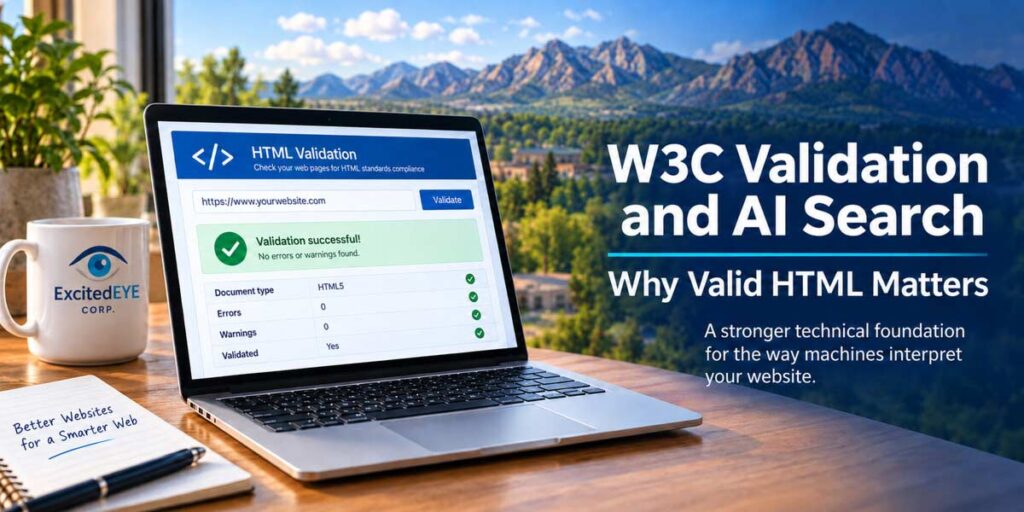
You Can Check Your Website Yourself
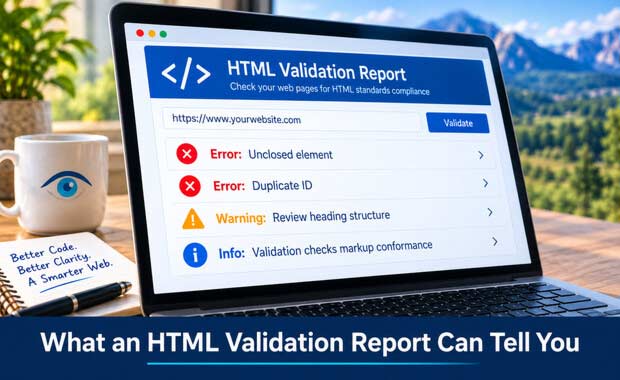 One thing I appreciate about W3C validation tools is that you do not have to take anyone’s word for the condition of your markup. You can check it yourself.
The W3C Nu HTML Checker lets you enter a webpage URL and examine its HTML. It reports errors, warnings, and informational messages based on current web standards. W3C also provides a CSS Validation Service for checking the style-sheet code that controls much of a page’s presentation.
Try your homepage. You may receive zero errors, a short list, or far more messages than expected.
Do not immediately assume that a long list means your website is broken. Browsers are extremely forgiving. They routinely interpret imperfect markup and try to determine what the developer intended.
That distinction matters: a website can look perfectly normal to a person while still containing technical problems underneath.
So What Does This Have to Do with AI Search?
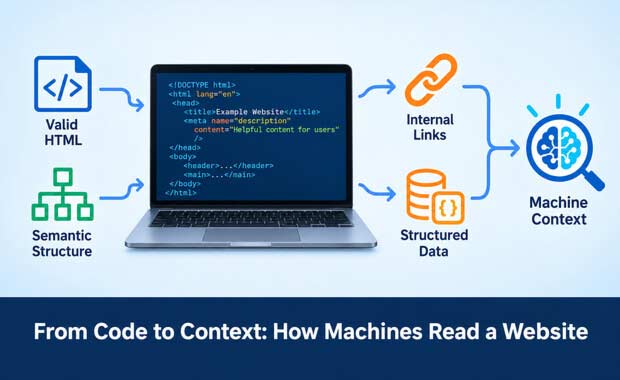 AI Search is not simply about publishing articles that contain the right keywords. Search systems must discover information, process it, determine what it represents, and understand how different pieces of information relate to one another.
Your website is part of that information environment.
HTML supplies the underlying document structure. Semantic HTML can add meaning. Your content supplies the information. Internal links connect related pages. Structured data can describe people, organizations, services, and other entities in a machine-readable format. Technical settings determine whether important content can be crawled and indexed.
Google makes an important distinction here. Its guidance says there are no additional technical requirements or special optimizations for appearing in AI Overviews or AI Mode. The established SEO fundamentals still apply: crawlable pages, visible text, useful internal links, accurate structured data, and consistent business information.
W3C validation is not an AI ranking score. Reaching zero errors does not guarantee that Google or an AI system will rank, cite or recommend your business.
What validation provides is more fundamental: a standards-based way to examine one important technical layer of your website.
Invalid HTML Can Affect More Than Appearance
Most conversations about invalid code stop at whether a page still looks right. Search systems must also interpret elements that visitors never see, including page titles, meta descriptions, canonical links, and structured data.
Google specifically recommends using valid HTML for page metadata. It explains that although Google tries to understand invalid or inconsistent markup, certain errors inside the document <head> can affect how later metadata is processed.
That does not mean every validation warning damages search performance. It does mean some markup errors can have real consequences, and a browser rendering the visible page correctly is not proof that every machine-readable element has been interpreted as intended.
Think About Your Website Like a Vehicle
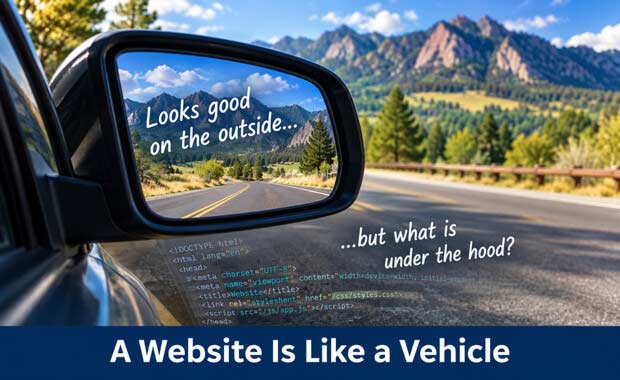 Living and working around Longmont and Boulder, I think there is a useful Colorado analogy.
You can look at your vehicle and think everything is fine. The paint looks good, the interior is clean, and it starts every morning. That does not necessarily tell you what is happening underneath the hood.
Your website is similar.
The visible portion is what customers experience. They see the design, read the content, use the navigation, and hopefully contact you.
The underlying code is a different layer. Browsers, search engines, accessibility technologies, and other software must interpret that code to present and process the page. Validation gives you a way to inspect part of that underlying layer instead of judging the entire website by what appears in a browser window.
Zero Errors Is Good. It Is Not the Finish Line.
Suppose you run your website through the validator and receive a beautiful zero-errors result.
Great. That is worth knowing—but do not stop there.
Valid HTML does not automatically mean your website is technically excellent. It does not tell you whether important pages are indexed, whether your structured data accurately represents your business, or whether search systems can clearly connect your organization, services, locations, people, and expertise.
Those are different questions.
This is why I approach technical SEO and AI Search optimization as a set of connected layers rather than one magic fix. The technical foundation matters. So does the content built on top of it. So do the relationships created through internal links, structured data, and consistent external sources.
The goal is not merely to make a website look good. The goal is to make its information accessible, coherent, and understandable.
What Should You Check?
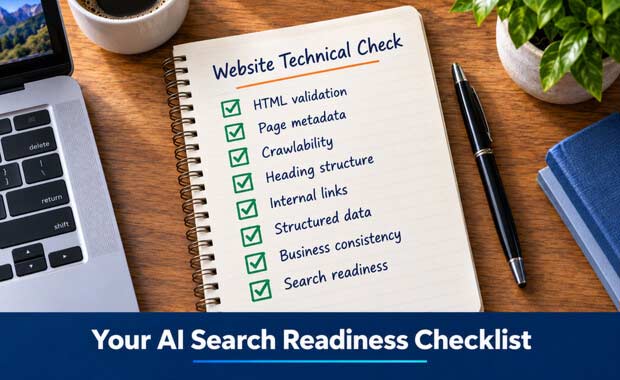 Start with the basics. Run your homepage through the W3C Nu HTML Validator. Then try the W3C CSS Validator if you want to inspect the presentation layer as well.
Do not treat every warning as equally serious. Look first for errors that could change document structure, interrupt metadata, create duplicate elements, break links or forms, or interfere with accessibility.
From there, ask the larger questions:
- Can search engines crawl and index the important pages?
- Are headings and semantic elements being used logically?
- Does the internal linking reveal how related pages fit together?
- Is the business clearly and consistently identified?
- Are important people, services, locations, and organizations represented accurately?
- Does the Schema.org structured data match the visible page content?
- Do the website, Google Business Profile, and other trusted sources tell the same story?
Most importantly, does your website tell machines the same story it tells your customers?
This is where validation connects with the larger technical SEO, entity, and AI Search conversation. A validator can identify syntax and conformance problems, but it cannot determine whether your entire digital identity is accurate and coherent. That requires a wider review of your semantic entity relationships, content, and technical architecture.
AI Search Still Starts with Your Website
There is a temptation to think of AI Search as something happening somewhere outside your website. It is not.
Your website remains one of the primary places where your business publishes information about who you are, what you do, where you operate, and what you know. For Google’s AI features, a page must still be indexed and eligible to appear in Search before it can be shown as a supporting link.
W3C validation is only one piece of that puzzle. It is not a substitute for technical SEO, helpful content, structured data, accessibility testing, page performance, or a comprehensive website audit. It is a straightforward way to test one part of the foundation for yourself.
Do not just trust the sales pitch. Check it.
Run the test. Review the results. Ask which issues matter and why.
If your website has zero W3C errors, that is useful information. If it does not, that is useful information too. Either way, you have learned something about the website representing your business online.
At ExcitedEYE Corp. in Longmont, Colorado, I look at websites from that larger perspective. The goal is not simply to make a site look good or chase the latest SEO buzzword. It is to build a website that is technically sound, useful to people, understandable to search systems, and prepared for the continued evolution of search.
Because the future of search is not only about getting found. It is about being understood.
Leave a Reply
You must be logged in to post a comment.