
Your Website Has a New Visitor: Is It Built for AI Agents?

For decades, website designers have worked from a familiar assumption:
- A human visitor arrives.
- Looks at the page.
- Interprets the navigation.
- Reads the content.
- Clicks the appropriate button.
That assumption has changed.
Customers are increasingly using artificial intelligence to research companies, compare services, summarize options, and make decisions. At the same time, a newer class of browser-based AI agents is emerging with the ability to move beyond simply presenting information.
Instead of only answering a question, an AI agent may attempt to navigate a website, locate the correct service, interact with page controls, complete a form, or gather information on behalf of a user.
Your website may soon be serving two very different visitors: the person who sees the finished design and the intelligent system trying to interpret and operate the architecture beneath it.
A website can appear perfectly clear to a person while remaining structurally confusing to a machine. Therefore, the next generation of website architecture will demand more than attractive design, strong rankings, or an installed schema plugin.
Customers and intelligent systems will also evaluate whether they can understand the interface, follow the customer journey, and successfully use the website.
A New Class of Website Visitor
AI search engines and AI agents are related, but they are not the same thing.
A traditional search crawler discovers pages, processes their content, and determines whether a search index should include them. An AI-powered search experience can then retrieve information from that index and use it to construct a response.
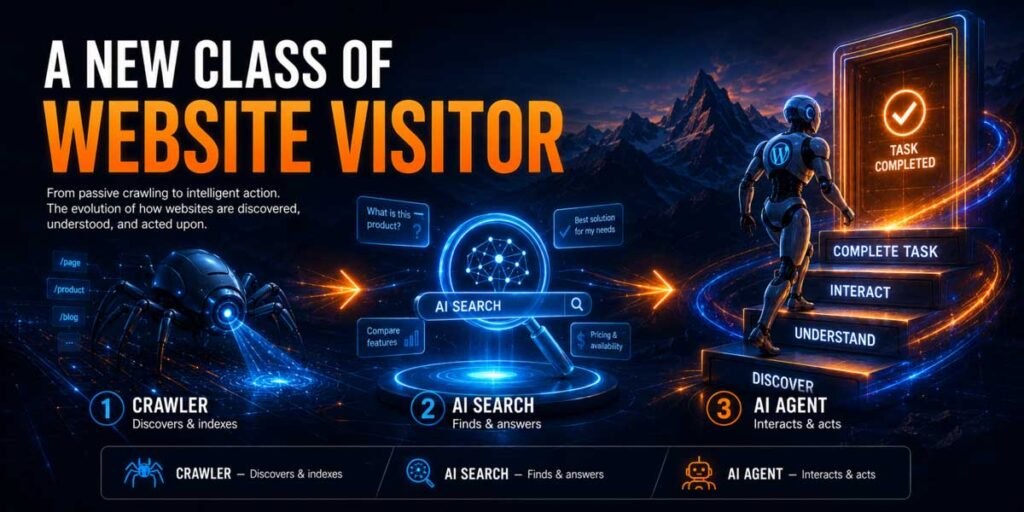
A browser agent may go a step further by attempting to interact with the website itself.
For example, a customer might ask an assistant to identify several qualified local providers, compare their services, determine which company appears to be the best fit, and locate the correct way to request an estimate.
Eventually, similar systems may help users schedule appointments, complete inquiries, gather product information, compare available options, or move through other multi-step customer journeys.
Not every AI assistant can currently perform every one of these actions. The technology remains an emerging and rapidly developing area. However, Google has already begun providing initial guidance related to AI agents, while emphasizing that established technical SEO and useful, accessible website experiences remain foundational.
Web.dev now describes autonomous browser agents as systems capable of interpreting a website, planning a journey, and executing actions for a user. According to its guidance, these agents may inspect screenshots, raw HTML, and the accessibility tree when trying to understand a page.
Consequently, business owners should not wait for agent-driven browsing to become universal before addressing obvious structural weaknesses. The websites that are easiest for agents to interpret will generally be the same websites that provide clearer, more dependable experiences for customers.
Being Found Is Not the Same as Being Usable
Much of the current conversation about artificial intelligence and websites focuses on visibility.
Businesses want to know whether their content can appear in AI Overviews, AI Mode, ChatGPT, Gemini, Perplexity, and other answer-driven experiences. That is an important concern, but it addresses only one stage of the customer journey.
Visibility does not guarantee usability.
A search system may successfully identify that a website offers WordPress development. However, an agent helping a prospective customer must determine which web services page is most relevant, whether the company serves the customer’s location, what action should come next, and whether the contact pathway actually works.
Similarly, a crawler may recognize that a form exists on the page. An agent must determine which fields belong to that form, what information each field requires, which control submits the request, whether an error occurred, and whether the submission was successful.
Traditional technical SEO asks whether search systems can discover, crawl, render, index, understand, and retrieve a page. Agent-ready architecture introduces an additional question:
Can an intelligent system successfully operate the website?
That distinction changes the technical standard.
A website should not merely expose information to machines. It should communicate what users can do, how those actions work, and what outcome follows each completed action.
How AI Agents Interpret a Website
A human visitor experiences a website as a finished visual composition. Typography, spacing, color, imagery, navigation, animation, and page hierarchy work together to create an overall impression.
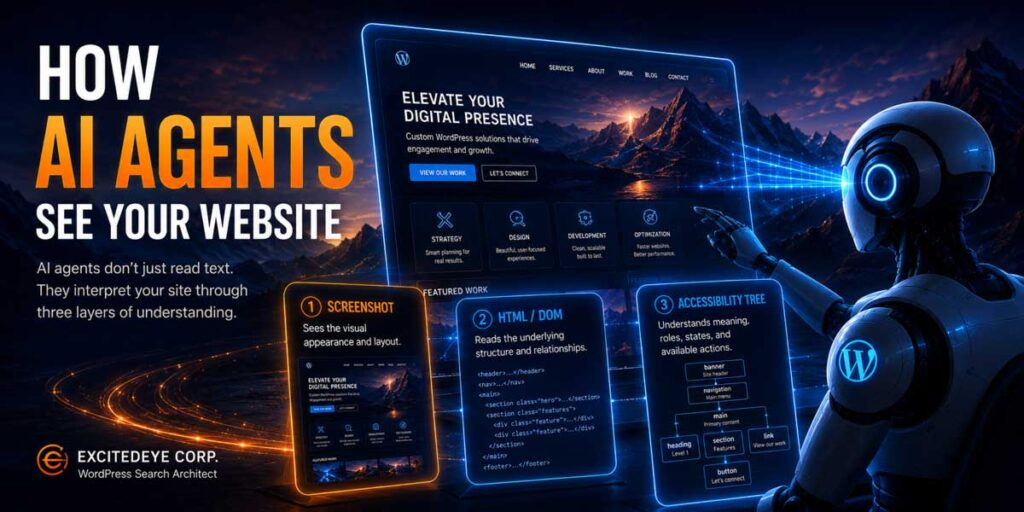
An AI agent may process a very different representation.
Current browser agents can examine websites through three primary views: the rendered screenshot, the underlying HTML or Document Object Model, and the browser’s accessibility tree. More advanced systems may combine these views to understand both the appearance and function of the page.
The Rendered Page
An agent may examine a screenshot much like a person looks at a screen.
Visual details such as size, contrast, position, proximity, and grouping can help it infer that an element is a button, navigation menu, search field, product card, or warning message.
A large call-to-action button may appear more important than a small footer link. Likewise, several similarly designed cards may visually suggest a collection of related services.
However, visual interpretation has limitations.
An element may look clickable even when a developer did not code it as a recognized interactive control. A transparent overlay may block a button even though the page appears normal. In addition, an animated layout may shift between the moment the agent examines the page and the moment it attempts to take action.
Visual web design should therefore reinforce the website’s underlying structure rather than serve as the only explanation of how the interface works.
The HTML and DOM
Beneath the rendered page, the browser processes the website’s HTML and constructs the Document Object Model, commonly known as the DOM.
The DOM represents the elements, attributes, text, nesting, and relationships that make up the page. Through this structure, an agent may determine that a heading introduces a specific section, a button belongs to a particular service card, or a form field supports a particular inquiry.
Proper structure supplies context.
By contrast, developers who assemble a website from hundreds of generic containers may provide fewer dependable signals about each element’s purpose. CSS can make almost any object look like a button, while JavaScript can make almost any element respond to a click. Nevertheless, appearance and behavior do not automatically communicate semantic meaning.
The Accessibility Tree
Browsers also create an accessibility tree based largely on the DOM. This representation includes accessibility-related information about the elements on the page. Assistive technologies such as screen readers use it to interpret the interface.
The accessibility tree may identify an element’s name, role, description, state, and available actions. For example, it can help distinguish a link from a button, an expanded menu from a collapsed one, or a labeled form field from an unidentified text box.
In practical terms, this structure can help an agent tell the difference between something that merely looks interactive and something the browser understands to be interactive.
That difference matters.
A person may see a familiar visual pattern and correctly assume how it works. A machine needs reliable signals explaining the element’s role and relationship to the rest of the page.
Why These Views Must Agree
No single representation tells the entire story.
A screenshot may communicate visual priority without explaining a control’s programmatic role. The DOM may reveal how elements are nested without fully explaining their visual importance. Meanwhile, the accessibility tree may clearly communicate the function of a control while providing less information about the broader visual context.
An agent may combine all three.
Therefore, one new file, plugin, or special piece of markup cannot create an agent-ready website. A website becomes agent-ready when its visual design, semantic structure, accessibility information, and interactive behavior support the same customer journey.
Why Polished Websites Can Still Confuse Machines
A website can look beautiful and still contain serious structural weaknesses.
Modern WordPress themes and page builders give designers enormous visual flexibility. They make it possible to create animated panels, layered sections, unconventional navigation, interactive cards, and custom controls without directly editing the underlying HTML.
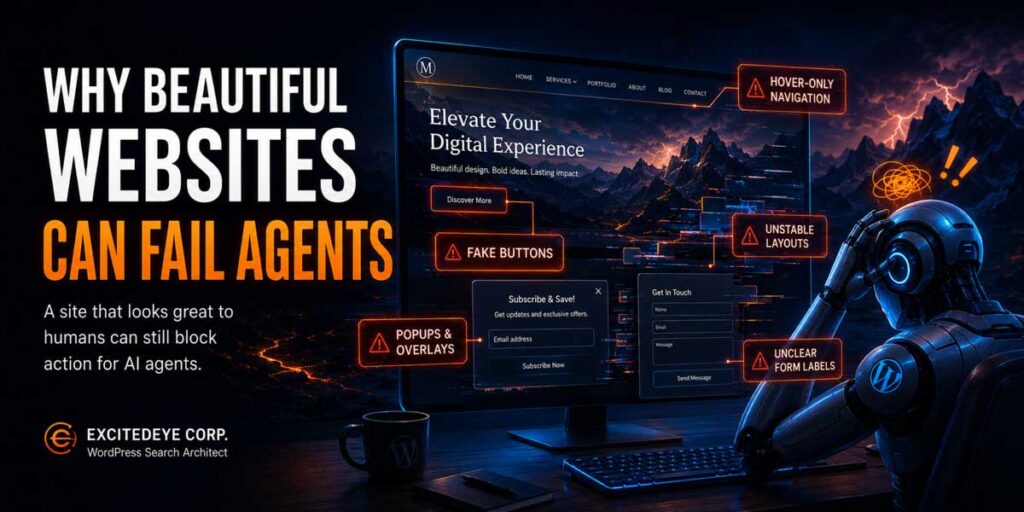
That flexibility is valuable. However, it can also produce interfaces that appear sophisticated while relying on weak or ambiguous structure.
A custom object may look and behave like a button even when the browser does not recognize it as one. A submenu may appear only after a precise hover movement. A form may use disappearing placeholder text instead of dependable labels. Meanwhile, a delayed popup or chat window may cover the primary call to action just as an agent attempts to interact with it.
Layout instability creates another source of uncertainty. An agent might identify a control and prepare to select it, only for a promotional banner, late-loading image, or third-party widget to shift the page.
To a human visitor, these problems may create mild irritation. To an automated system attempting to execute a precise action, they can cause the journey to fail entirely.
The issue is not that modern websites should become visually plain. Rather, the engineering beneath the design must be as intentional as the design itself.
The Business Impact of Agent Usability
It is easy to dismiss agent-ready website architecture as a problem for the distant future.
However, the broader shift is already visible. Customers are delegating more research and decision-making to AI agent systems, and Google has explicitly identified AI agents as an emerging area for website owners to evaluate.
As these systems become more capable, the quality of the website’s structure may influence whether an agent can confidently recommend a business, identify the correct service, or complete the next step in a customer journey.
Consider a customer searching for a local website-development company. An AI agent may successfully identify several providers, but its work does not necessarily end with a list of names.
It may also need to determine:
- Which company genuinely provides the requested service
- Whether the company serves the customer’s location
- Which service page best matches the request
- Whether consultation information is available
- How the business prefers to receive inquiries
- Whether the contact action functions correctly
- Whether the website confirms receipt of the request
A company can lose that opportunity even when its website ranks well and looks professional.
The opportunity may disappear because the service relationship is unclear, the navigation is ambiguous, or the forms lack dependable structure. An unstable interface may also hide an important control.
In other words, technical friction may become invisible competitive friction.
Agent-Ready Is Also Human-Ready
Businesses should not optimize websites for machines at the expense of people.
Fortunately, the strongest agent-ready improvements are also human-centered improvements.
Clear navigation helps visitors find the right service. Stable layouts reduce frustration and accidental clicks. Proper form labels make inquiries easier to complete. Recognizable controls help keyboard and assistive-technology users. Explicit confirmation messages reassure customers that an action succeeded.
Semantic HTML also gives browsers and assistive technologies a clearer representation of page structure. Web.dev demonstrates that semantic markup creates more meaningful landmarks in the accessibility tree than pages built from undifferentiated containers.
As a result, businesses should not treat agent readiness as a separate layer attached to user experience. Instead, they should use it as a technical test of whether the experience is genuinely clear, stable, and operable.
A website that communicates effectively with browsers, assistive technologies, search engines, and intelligent agents will usually provide a stronger experience for human visitors as well.
The Next Evolution of Website Architecture

The rise of AI agents does not make traditional web design, technical SEO, accessibility, or structured data obsolete.
Instead, it brings those disciplines closer together.
Search visibility still depends on accessible, indexable, useful content. Google continues to state that established SEO practices remain relevant to generative AI search and that website owners do not need special AI markup for inclusion in its AI search features.
However, visibility is only the beginning.
Once an intelligent system reaches the website, the quality of the interface becomes part of the equation. The system must determine who the business is, what it provides, what actions the interface offers, and whether those actions produce a reliable result.
That requires more than superficial optimization.
It requires a website whose visible design, content architecture, semantic structure, accessibility information, and interactive behavior all tell the same story.
The Technical Guardian Takeaway
Your website’s next visitor may not be a person manually clicking through every page. It may be an intelligent system researching options, evaluating your services, or attempting to complete a task for someone else.
That does not mean businesses should abandon traditional SEO. It’s not the time to chase speculative protocols or redesign their websites for robots. Instead, it means the technical quality of the website matters more than ever.
A resilient website should communicate clearly through every layer. The design should reveal what matters. The content should identify the business and its services, and the underlying structure should explain how the interface functions.
When those layers agree, human visitors gain confidence and intelligent systems encounter fewer reasons to become confused.
Agent-ready architecture is not a gimmick. It is the next extension of well-engineered web design.
ExcitedEYE Corp. helps businesses throughout Longmont, Boulder, Denver, and the Colorado Front Range build faster, stronger, and more understandable WordPress websites. From semantic content architecture and structured data to code hygiene, performance engineering, accessibility, and conversion pathways, every layer should support the same objective.
The implementation guide is now available: How to Build and Audit an Agent-Ready WordPress Website. It examines how semantic HTML, accessible controls, stable rendering, and technical audits can prepare a WordPress website for both human visitors and AI agents.
Build for the customer. Structure for the machine. Engineer for both.
Leave a Reply
You must be logged in to post a comment.