
Beyond Keywords: How to Build a Semantic Entity Graph for AI Search Engines
For years, businesses were told that search engine optimization started with keywords.
First, find the phrases your customers type. Then place those phrases in page titles, headings, service descriptions, image attributes, and blog posts. According to the traditional playbook, enough relevant content would help search engines understand what your business offers.
That approach is not entirely obsolete. After all, keywords still help search systems understand language, subject matter, and search intent.
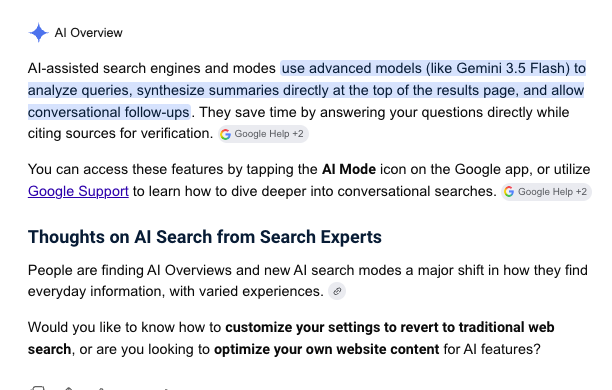
However, keywords alone are no longer enough, any longer…
Modern search systems must determine more than whether a page contains the right words. More specifically, they must determine what real-world business the page represents, which people are responsible for its content, what services the business actually provides, where those services are available, and how all of those facts relate to information found elsewhere.
In other words, this is the difference between writing pages that mention topics and engineering a website that defines entities.
Consequently, that distinction is becoming critical for businesses competing in AI-assisted search results.
Google states that its established SEO practices continue to apply to AI Overviews and AI Mode. There is no separate “AI schema” or secret optimization that guarantees inclusion. However, Google also confirms that structured data gives its systems machine-readable information about a page and helps them understand its content.
Therefore, the opportunity is not to chase an imaginary AI-search loophole.
Instead, the opportunity is to remove ambiguity.
The Shift From “Strings” to “Things”
Traditionally, keyword optimization focused heavily on strings: combinations of letters and words appearing within a document.
Why Keywords Cannot Define the Business
For example, a business might repeat phrases such as:
- WordPress web design
- Longmont SEO company
- Website development
- Technical SEO services
- Digital marketing agency
Those phrases provide topical signals. In other words, they tell a search system what the page discusses.
Nevertheless, they do not necessarily tell the system what the business is.
Is the company a legally established organization or an informal project? Does it have a physical location? Is Longmont its actual business location, its service area, or simply a city inserted into the copy? Does the company genuinely provide WordPress development, or did a writer add that phrase to attract traffic? Who created the content? What other pages, profiles, and independent sources support these claims?
How Evidence Becomes a Graph
 A human reader may infer the answers from context. By contrast, a machine must resolve them from available evidence.
Specifically, that evidence can include:
- Visible website content
- Page titles and headings
- Internal-link relationships
- Structured data
- Business profiles
- Author and company pages
- External references
- Consistent names, addresses, identifiers, and descriptions
- Connections among services, people, locations, and organizations
As a result, each identifiable subject becomes a potential entity, or “thing.”
Your company is an entity.
The founder is another entity.
A physical office can be an entity as well.
Likewise, each defined service can be treated as an entity.
In addition, your city, professional specialty, articles, credentials, projects, and business profiles can contribute additional nodes and relationships.
Ultimately, the goal is not to create the largest possible collection of schema markup. Instead, it is to create a coherent model in which every legitimate node supports the same business identity.
For example, consider the difference between these two statements:
We provide WordPress web design in Longmont.
And:
ExcitedEYE Corp. is a WordPress web design and website development company located in Longmont, Colorado, serving businesses throughout Boulder, Denver, and the Colorado Front Range.
The first sentence targets a keyword phrase.
By contrast, the second begins to define an organization, a business category, a physical relationship, a service, and a geographic footprint.
When that visible statement is reinforced through accurate Organization, LocalBusiness, Service, Person, Article, and WebPage relationships, the website begins operating as a semantic entity graph rather than a collection of loosely related marketing pages.
How AI Scrapers Build a Brand Knowledge Graph
Unlike a human visitor, an AI system does not arrive at your homepage with assumptions, local knowledge, or intuition.
Instead, it must gather information from the material it can access.
How Crawlers Interpret the Evidence
 First, search crawlers discover pages, process their content, follow links, and add eligible information to an index. Meanwhile, structured data provides an additional standardized layer that classifies what a page describes and identifies relationships that may be less obvious in prose. For that reason, Google recommends JSON-LD as a supported structured-data format and requires the markup to accurately represent content visible on the page.
For comparison, think of your website as a legal deposition.
The visible page content is your testimony.
Then, your structured data identifies the people, organizations, places, services, and documents involved.
At the same time, your internal links demonstrate how those subjects relate.
Finally, external business listings and trusted references act as corroborating evidence.
If every component supports the same account, the testimony becomes clearer.
Why Fragmented Signals Create Uncertainty
However, the testimony becomes fragmented when one page identifies the company as a web-design agency, another describes it as a generic marketing consultant, the footer uses a different business name, the About page omits the people behind the company, and automatically generated schema creates several disconnected organizations.
In that case, the issue is not merely that a schema validator might display a warning.
More importantly, the deeper problem is unresolved identity.
Consequently, a crawler may encounter several names, URLs, descriptions, and implied business types without a reliable way to determine whether they describe one entity, multiple departments, separate locations, or unrelated businesses.
Therefore, installing a schema plugin is not the same as building a knowledge graph.
A plugin can output code.
However, it cannot automatically determine the most accurate model of your company.
Nor does it know which entity should be canonical, how your local operation relates to your corporate identity, which person should be connected to an article, whether two services require separate entities, or which automatically generated markup conflicts with custom code.
Ultimately, those decisions require architecture.
The Core Elements of an AI-Ready Website Architecture
 A strong semantic graph does not need to be unnecessarily complicated. It needs to be accurate, internally consistent, and deliberately connected.
Three areas form the foundation.
1. Clean Parent and Local Anchors
Many business websites blur the distinction between the company and the place where the company operates.
Those are related concepts, but they are not always identical.
An Organization entity can define the overarching company through properties such as its official name, alternate name, URL, logo, founding date, contact information, identifiers, and verified external profiles.
A LocalBusiness entity can define a particular physical business or branch through its address, telephone number, geographic coordinates, opening hours, service area, and locally relevant business type.
Google recommends using the most specific applicable organization or local-business type and providing accurate real-world and online details. Its documentation also explains that organization information can help Google identify a business, while local-business data can describe physical locations and departments.
Therefore, the relationship between these entities must be intentional.
A strong architecture may define:
- One canonical corporate organization
- One primary website associated with that organization
- A physical local-business entity connected to the organization
- A consistent address and telephone number
- Stable
@idvalues that other pages can reference - Verified
sameAsprofiles - Services provided by the correct organization or location
- Articles published by the organization and written by identified people
Of course, the exact model depends on the business.
 A single-location professional firm may need only a straightforward company and location relationship. A company with several branches, departments, brands, or service territories may require a deeper hierarchy.
Regardless of complexity, the critical requirement is consistency.
Do not allow the homepage, footer, About page, location page, SEO plugin, theme, and custom JSON-LD to independently create competing versions of the business.
Choose the canonical entities. Assign stable identifiers. Connect everything back to them.
2. Explicit Authorship and Founder Mapping
A website should not appear to have materialized without human involvement.
When a business publishes professional guidance, technical analysis, medical information, legal commentary, financial content, or strategic advice, readers and machines should be able to determine who created it and why that person is qualified to discuss it.
Establishing that accountability requires more than placing “Admin” beneath an article title.
A properly developed author entity may include:
- The person’s real name
- Professional role
- Relationship to the organization
- Areas of knowledge
- Biography
- Profile image
- Author archive or profile page
- Relevant credentials
- Selected work
- Verified professional profiles
- Articles written or reviewed by that person
Article markup can then reference the established author entity instead of creating a new, disconnected person every time a post is published.
Where appropriate, the organization can also identify its founder, owner, leadership, or team members through valid relationships. A dedicated profile page can make a person or organization the page’s main entity, and articles can connect back to that creator.
This does not mean stuffing personal data or credentials into every page.
It means establishing accountable authorship.
For a founder-led company, founder mapping can be especially powerful because it connects the history, expertise, and body of work of a real person to the company’s identity.
The graph can communicate:
- The founder established this organization.
- That person works for the organization.
- Their documented expertise supports the subject matter.
- The same person wrote or reviewed this article.
- Meanwhile, the organization published the article.
- Finally, the article discusses a service the organization actually provides.
Together, those statements create explicit relationships.
Without those relationships, however, a search system may recognize an article’s topic while remaining uncertain about the source behind it.
3. Unambiguous Service Silos
A list of services on a homepage is not a complete service architecture.
If a company provides WordPress development, technical SEO, local SEO, website maintenance, schema engineering, and digital marketing, placing all six phrases into one paragraph does not clearly define the scope, audience, process, or provider of each service.
Every strategically important service should have a dedicated, indexable destination.
That page should explain:
- What the service is
- Who provides it
- Who it is for
- What problems it addresses
- How the work is performed
- Where the service is available
- What related services support it
- What evidence demonstrates competence
- How a prospective customer can take the next step
The structured layer can reinforce those visible facts by identifying the service, its provider, relevant area served, associated offers, audience, and relationship to the organization. Schema.org’s Service vocabulary specifically supports connecting a service to the Organization or Person that provides it.
Internal linking then establishes the wider semantic silo.
For example, a WordPress web-design service page might connect to:
- The primary organization entity
- The company’s Longmont location
- A WordPress development process page
- Relevant portfolio projects
- Technical articles written by the founder
- Website-maintenance services
- Technical SEO services
- A consultation or contact action
Those connections make the service more than text on a screen.
They turn it into a defined digital asset with a provider, purpose, body of supporting evidence, and place within the company’s larger knowledge graph.
Authority Depends on Corroboration
Structured data is valuable, but it is not a substitute for evidence. Adding founder, award, review, or areaServed properties does not automatically make an unsupported claim authoritative. Instead, the markup must accurately represent the visible page, and the visible page must accurately represent the real business.
Google explicitly warns against structured data that is misleading, irrelevant, hidden from users, or inconsistent with a page’s primary content. Although correct markup can help search systems interpret a page and make it eligible for certain search features, it does not guarantee visibility or rankings. Therefore, a reliable entity strategy must extend beyond the schema itself.
Identity consistency ensures that the same company name, location, logo, description, and contact information appear throughout the website and across trusted external profiles. Meanwhile, content consistency ensures that service pages, company information, portfolio examples, and articles all reinforce the same positioning.
Technical signals must support that identity as well. Canonical URLs, structured data, metadata, sitemaps, internal links, and indexation rules should reinforce the intended hierarchy rather than introduce competing versions of the business. In addition, business profiles, professional listings, customer reviews, media references, partnerships, and legitimate citations can provide external corroboration.
Finally, editorial accountability connects published content to the people and organization responsible for it. When these layers agree, the entity graph becomes clearer and more credible. Conversely, the graph becomes weaker when structured data makes claims that the visible website and the broader web cannot substantiate.
The Technical Guardian Takeaway
Modern SEO is no longer a superficial checklist, a keyword-density formula, or a plugin that can be installed and forgotten. It is an engineering and data-mapping discipline that requires a website to clearly define the company behind it, the people responsible for its content, the services it provides, the locations it serves, and the relationships connecting each of those elements.
The objective is not to manipulate an AI system into mentioning your brand. Rather, the objective is to build a consistent, useful, and technically coherent digital identity that gives machines fewer reasons to misunderstand it. Achieving that requires strong content, crawlable architecture, accurate structured data, stable entity identifiers, accountable authorship, focused service pages, intentional internal connections, and corroborating external signals.
Keywords can tell an algorithm which words appear on your website. A semantic entity graph goes further by explaining who you are, what you do, where you operate, and why your information should be associated with your business.
In an AI-driven search ecosystem, being understood is the first requirement for being considered.
ExcitedEYE Corp. helps businesses throughout Longmont, Boulder, Denver, and the Colorado Front Range build stronger WordPress websites, structured content systems, entity relationships, and search architecture. Do not leave it to search engines and AI systems to resolve a fragmented brand identity on their own.
Secure your graph before your digital footprint gets left behind.
Leave a Reply
You must be logged in to post a comment.