
The Who, What, Where, Why of Top English Search Engines! 🔍💡
In the vast landscape of the internet, search engines are our trusty guides, helping us navigate to the information we seek. But while Google dominates the conversation, are Bing and Yahoo just distant echoes? And what does it all mean for how your website gets found? Let’s dive in! 🚀
Are Bing and Yahoo the Same? What’s the Relationship? 🤝
This is one of the most common misconceptions in the search world! For many years, Yahoo Search has been powered by Microsoft’s Bing search engine.
Think of it this way:
- Bing is the engine ⚙️ (the technology that crawls the web, indexes content, and generates search results).
- Yahoo Search is the car 🚗 (the user interface and brand that presents those results).
So, when you perform a search on Yahoo, Bing is doing the heavy lifting behind the scenes. This means that from an SEO perspective, if you optimize for Bing, you are essentially optimizing for Yahoo Search as well. While Yahoo still has its own distinct brand identity and properties (like Yahoo Mail, Yahoo News), its core web search results largely mirror those of Bing.
Bing vs. Google: A Tale of Two Search Giants 🥊
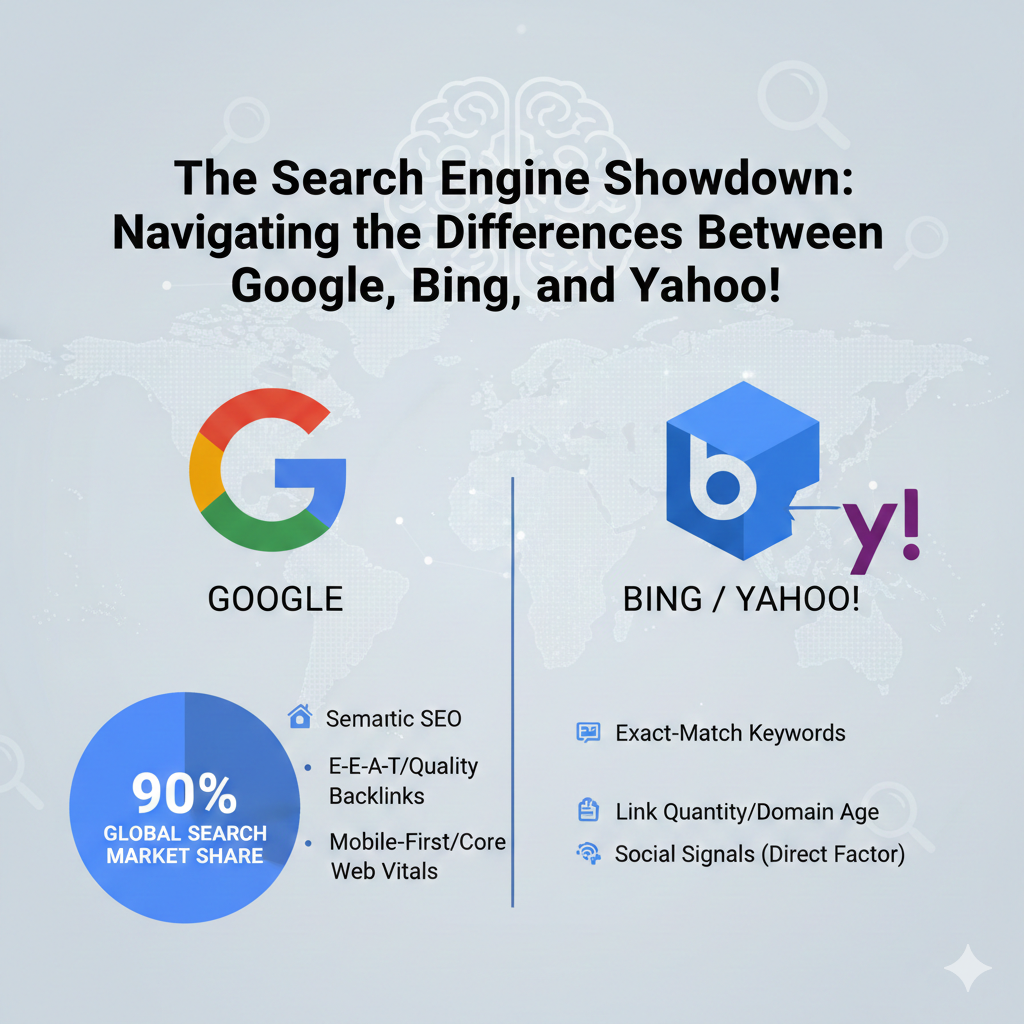
While Google, undeniably, holds the lion’s share of the global search market 👑, Bing (and by extension, Yahoo) still commands a significant user base, particularly in certain demographics and regions. More importantly, their algorithms have distinct preferences.
Here’s a breakdown of the key SEO differences:
-
Keyword Usage & Specificity: 📝
- Google Keyword Handling: Highly sophisticated in understanding semantic intent. It looks at synonyms, context, and related phrases. You don’t need to jam exact keywords into every spot; natural language is preferred. 🌱
- Bing Keyword Handling: Still appreciates exact-match keywords. Using your target keyword precisely in your title tags, H1 headings, and even URLs can carry more weight. It’s less advanced at inferring meaning outside of direct matches. 🎯
-
Backlinks (Offsite Authority): 🔗
- Backlinks for Google: Focuses heavily on the quality and relevance of backlinks. A link from a highly authoritative, related website is exponentially more valuable than many low-quality, irrelevant links. 💎
- Backlinks for Bing: Also values quality but seems to give more weight to the quantity of backlinks and the age/trustworthiness of the linking domain (e.g., .gov, .edu links are highly prized). 🏛️
-
Social Signals: 📣
- Google Social Signals: States that social shares (likes, retweets, etc.) are not a direct ranking factor. They can, however, indirectly help by driving traffic and increasing content discoverability. 📈
- Bing Social Signals: Has explicitly stated that social signals are a direct ranking factor. They view high engagement on social media as an indicator of a page’s authority and popularity. So, a viral post can directly impact your Bing rankings! 🌟
-
Technical SEO & Page Experience: 📱💻
- Technical SEO at Google: Pioneered mobile-first indexing and places significant emphasis on Core Web Vitals (page speed, interactivity, visual stability). A fast, mobile-friendly site is crucial. ✅
- Technical SEO at Bing: While user experience is always good, Bing is generally seen as less strict regarding mobile-first indexing and Core Web Vitals. It’s often more “desktop-agnostic.” 🖥️
-
Voice Search: 🗣️
- Google’s Voice Search: Dominates voice search through Google Assistant, Android, and Google Home devices. Voice search queries tend to be longer and more conversational.
- Bing’s Voice Search: Powers voice search for Cortana, Amazon Alexa, and Xbox. Optimizing for conversational, question-based queries is key here too. 💬
Yahoo vs. Google: An Extension of the Bing Story 🗺️
Since Yahoo Search results are powered by Bing, the differences between Yahoo and Google SEO are largely the same as those between Bing and Google.
However, Yahoo’s ecosystem does offer some unique points for visibility:
- Yahoo News/Finance/Sports: Being featured or creating content relevant to these highly trafficked Yahoo properties can drive significant referral traffic, even if it doesn’t directly impact your search ranking in the same way a backlink would. 📰
- Local SEO (via Bing Places): Listing your business on Bing Places for Business will also help your visibility on Yahoo Local searches. 📍
Is Yahoo Even Top 3 Anymore? What Other Search Engines Matter? 🤔
Globally, no, Yahoo is not typically in the top 3. The landscape is dominated by:
- Google: The undisputed leader, holding over 90% of the global search market share. 🌍
- Bing: Solidly in second place, though with a much smaller share (often between 2-6% depending on the region). 🥈
- Baidu: The dominant search engine in China, essential for anyone targeting that market. 🐉
Comparatively, other notable search engines, each with its own niche and SEO considerations, include:
- DuckDuckGo: A privacy-focused search engine that is growing in popularity. 🛡️
- Yandex: The leading search engine in Russia. 🇷🇺
- YouTube: Often considered the second-largest search engine in the world, specifically for video content. 📹
- Amazon: For product searches, Amazon is often the first stop for consumers. 🛍️
Smart Searching FAQ: Getting the Best Results
Q1: What is “Search Intent,” and why does Google prioritize it?
Search Intent is the “why” behind a user’s query. Is the user looking to buy something (Transactional Intent), learn something (Informational Intent), or navigate to a specific site (Navigational Intent)? Google prioritizes this because a search engine’s primary job is to provide the most satisfying answer. If you search “best shoes,” Google knows you probably want reviews and shopping links (Transactional/Informational), not just the dictionary definition of the word “shoe.”
Q2: Should I use quotation marks in my searches?
Yes! Using quotation marks (” “) forces the search engine (Google, Bing, or Yahoo) to look for that exact phrase in that exact order. This is incredibly useful for finding specific quotes, troubleshooting error messages, or locating exact titles. It helps filter out noise caused by keyword synonyms.
Q3: Which search engine is best for general knowledge vs. current news?
- General Knowledge/Deep Research: Google is generally superior due to its vast index and advanced ability to analyze and synthesize information from diverse sources (semantic understanding).
- Current News/Real-time Events: Both Google and Bing are excellent. Bing often excels because its index updates quickly, and its related search products (like news tabs) are integrated with Microsoft platforms.
Q4: How can I search for information on only one specific website?
Use the site: operator in your query. This is universally supported by all major search engines.
Example:
site:wikipedia.org "search engine showdown"
This tells the engine to only return results for the phrase “search engine showdown” that appear on the wikipedia.org domain.
Q5: Is Bing better for video or image searches?
Many users and reviewers note that Bing’s image search interface is superior, offering better organization, filtering, and high-quality image previews. However, for videos, YouTube (owned by Google) is the dominant platform, making Google Search and YouTube the overall best resource for finding video content.
Q6: Why do my search results look different when I use a private browser window?
When you are logged into Google or Bing, the search engine personalizes your results based on your location, search history, and past clicks. A private or incognito window removes this personalization, giving you a more objective, non-biased view of how the engine ranks content. This is a smart way to test your SEO performance!
Leave a Reply
You must be logged in to post a comment.